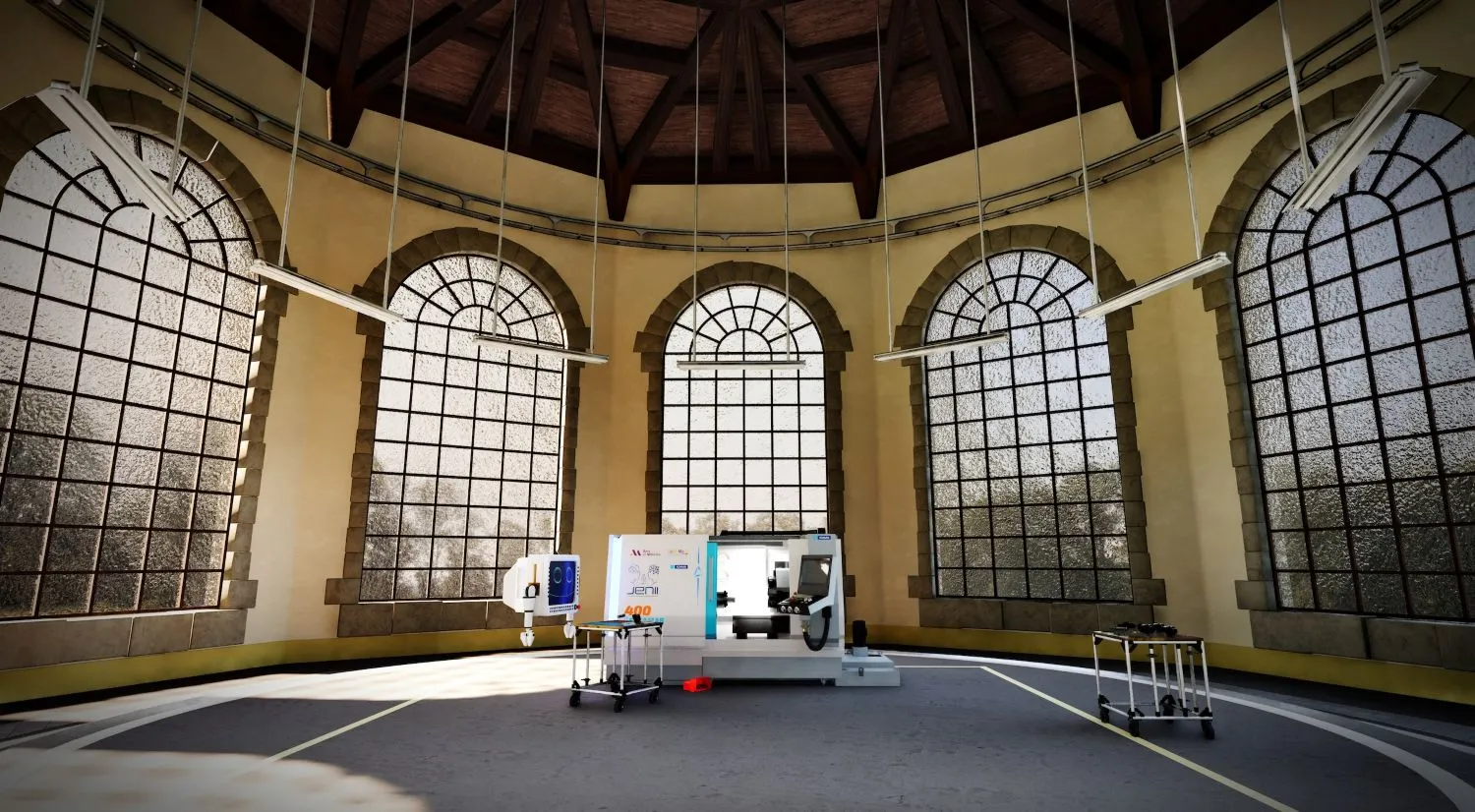
JENII
A real-time, greenfield digital twin of an industrial CNC machine tool.
TECHNOLOGIES
The load on a cutting tool is something operators normally only feel as vibration or hear as a change in pitch. At JENII I led the build of a real-time digital twin that turned it into something you can watch: cutting forces — both measured on the machine and simulated live — rendered as vectors and curves on a 3D model beside the machine and inside the machine’s own control screen. It’s the most literal “showing the invisible” I’ve built.
What it was
JENII was a French national research program building immersive digital-twin demonstrators for industry and academics — four research partners (Arts et Métiers among them), 15 twins in total. I built and owned one of them: the industrial machining twin — among the program’s most advanced. It drew direct interest from several industrial partners and was shown twice at the Global Industrie trade fair. That put me two and a half years inside one of the country’s top high-precision machining labs (LaboMaP), building greenfield from zero, alongside the researchers who model the physics.
Physics in the loop
Force data came from two sources at once: the machine’s PLC (live current and power draw) and piezoelectric dynamometers mounted on the tool for true cutting effort. Against that, an analytical force model ran in real time on a Raspberry Pi at the edge, it provided cutting forces vectors, and also surface finish estimation; we also validated a higher-fidelity finite-element model (near real-time) built by a partner lab. My job wasn’t to write the solver — it was to turn a researcher’s physics into a live, productized twin: integrate it, stream it, render it, and keep the digital and physical machines in sync.
The platform
The twin connected to the real machine over OPC-UA, read the loaded blank and mounted tools, and generated the matching 3D model and configuration automatically — no manual setup. Around it I built a suite: a WebGL machine-architecture configurator (it replaced an unusable Siemens tool and exports a config any twin can consume), a VR trainer with a 1:1 exploded view of the machine and a virtual instructor, and a Grafana layer for live and replayed telemetry.
My role
Product Owner & lead developer — I built the platform largely single-handed over two and a half years: deciding what to build, owning the roadmap, and shipping it. I partnered with a researcher on the force-model integration — specifying how his model’s output should be structured so the twin could consume it live — and coached two junior developers through the VR trainer to fully autonomous ownership.
By the numbers
~300 ms end-to-end latency at 500 Hz over OPC-UA. Lathes and mills, 2 to 5+ axes. Siemens 840D & SINUMERIK One (adaptable to other controllers). Industrial partners Siemens and Somab; academic partner Arts et Métiers (ENSAM). Designed to roll out across high schools in several French regions.
Stack
Unreal Engine 5 · WebGL/Three.js · Siemens SINUMERIK (840D / One) · OPC-UA · MQTT · Raspberry Pi · InfluxDB · Grafana.